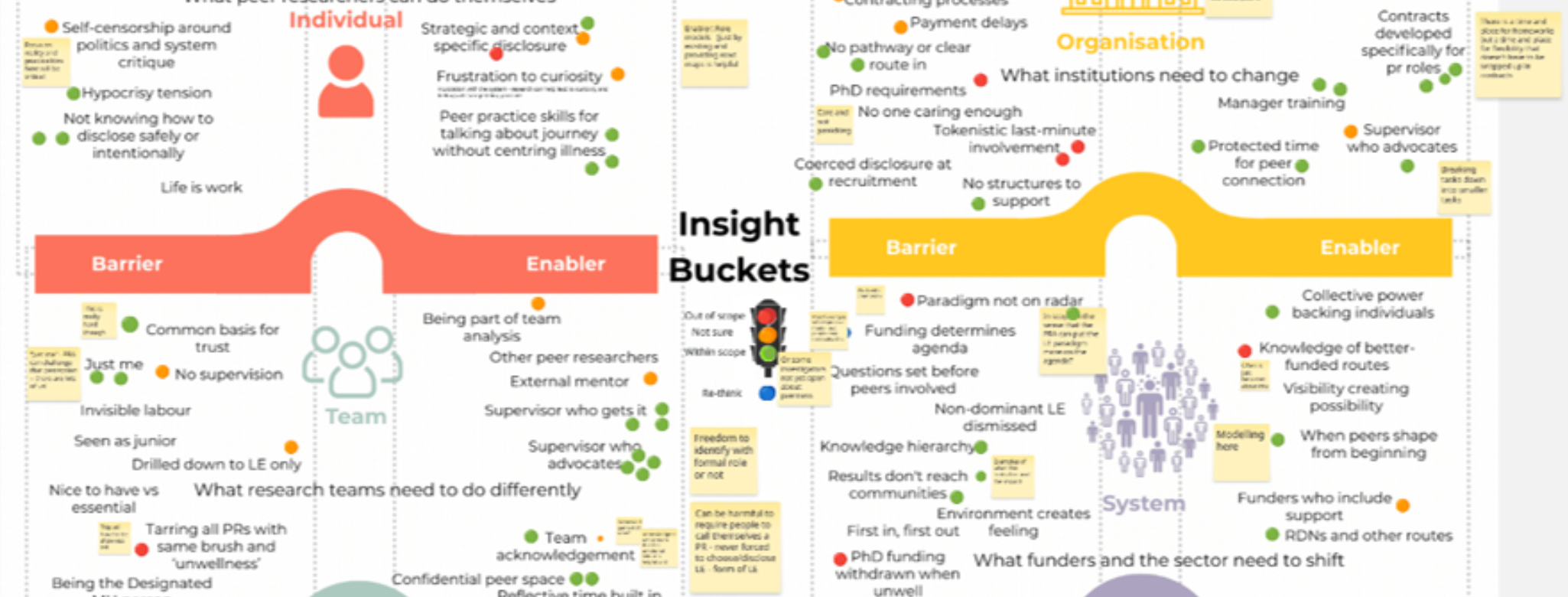
Understanding what peer research needs to thrive
"This report is going to give us such a good start on the work, and there are so many details in there that I hadn’t even thought of…I absolutely love what you’ve produced, and thank you so much for all of the thought and effort that has gone into it"
- Stefan Rennick Egglestone, Principal Research Fellow, School of Health Sciences, University of Nottingham
A partnership built on lived experience
We are proud to be a delivery partner on the Peer Research Academy, an initiative commissioned by Wellcome Trust and led by the University of Nottingham's Institute of Mental Health. Alongside our partners at Intentional Peer Support, we are working to support the development of peer research in mental health as an inclusive, accessible practice that people can thrive in.
The Peer Research Academy opened in September 2025 and will run until the end of 2027. Habitus are leading the discovery and evaluation work, and supporting Intentional Peer Support to bring IPS practice into the Academy's design. Every person leading this project brings their own lived experience. It is rare for a project of this scale to be entirely led by people with lived experience, and we think that kind of leadership is important for what this work is trying to do.
The question at the heart of the work is simple but important: What happens when research is led by those with lived experience and peer practice expertise, and what needs to be in place for that to happen well?
Challenges
Peer research is growing. More funders are asking for lived experience involvement, more projects are recruiting peer researchers, and more people with lived experience are stepping into research roles. But the infrastructure has not kept pace. Too often, peer researchers are brought in at the margins of studies that were designed without them, given titles without any real authority, or are left without the networks, training, and support that would help them thrive.
Before the Academy could build something to respond to this, it needed to understand the reality of peer research as it is experienced now. That meant listening carefully to the people doing the work, hearing about what helps, what gets in the way, and what needs to change, and doing so in a way that honoured their expertise.
What we did
We led the discovery research phase of the Peer Research Academy work, designed from the start to be participatory and led by lived experience.
Listening across contexts. We conducted interviews and focus groups with peer researchers, research leaders, and organisations. In total, 53 people shared their time, their expertise, and their experiences with us. They came from a range of contexts across the UK, North America, Australasia, Europe and South Asia, which allowed us to hear how peer research plays out in very different settings, and what issues are baked into the role and which are context driven.
Making sense of it together. We ran participatory sensemaking sessions so that the people whose experiences sat behind the data helped shape what it meant. This kept the analysis grounded in lived experience and ensured the findings reflected what mattered most to the people who had spoken to us.
Writing the report with peer researchers. We brought everything we heard together into a discovery phase report titled "What We Heard: The Conditions for Peer Research to Thrive." Community peer researchers on the project team conducted interviews, contributed to analysis, and brought their own expertise to every stage. The report acknowledges and holds every voice that contributed, as central to the work.
Connecting to our wider practice. The discovery work drew on everything we know about participatory research, co-production, and lived experience practice, and it connects directly to our wider work through the International Peer Leadership Network and our Shared Power, Shared Recovery paper on lived experience and peer leadership.
What we heard
The discovery phase uncovered rich, challenging, and honest insights.
The clearest message was that the barriers peer researchers face are systemic and not individual. People named far more barriers than enablers, and those barriers sat in structures, contracts, and cultures. We heard that peer researchers bring a distinctive expertise that changes what research is able to see, not just adding a distinct perspective to work that would have happened anyway. We heard that belonging and solidarity often matter more than training, and that connection to others doing the same work can be the thing that sustains someone in a difficult role. We heard that current supervision models do not always fit peer research, that co-production is too often tokenistic, and that financial and contractual precarity runs through almost every story. We also heard how hard it can be to get findings back to the communities they came from.
How we made a difference
The discovery report has given the Peer Research Academy a foundation built on what peer researchers actually said they need. Because the analysis was done with peer researchers through participatory sensemaking, the findings carry the authority of the people they describe.
The report names things that the wider research culture is only beginning to catch up with, and it does so in plain language that peer researchers, academics, funders, and people without research backgrounds can all read. It is already shaping the design of the Peer Research Academy, including the individually tailored support packages opening to peer researchers from 2026, the training course planned for 2027, and the peer research conference in Nottingham in September 2027.
You can read the full discovery phase report, "What We Heard: The Conditions for Peer Research to Thrive” by clicking on the link below. And you can learn more about the Peer Research Academy on our blog: The Peer Research Academy: Exploring What Happens When Research Is Led by People with Lived Experience.
Habitus has deep expertise in participatory research, co-production, and lived experience led discovery work. If you are looking to understand a field through the people who know it best, and to turn what they tell you into something that can shape practice, get in touch.